

Active systems
Mosquito hearing
Mosquito hearing
Active auditory mechanics, receptor modulation and sex-specific tuning.
Eight provisional project stories show how the final site could turn complex sensory physiology into concise, visual narratives. Every animation, title and description below is a placeholder for later refinement.
Explore the moving previewsInspired by motion-led research portfolios, this page treats each project as a visual entry point rather than a static text block. The final version could replace these loops with high-speed footage, electrophysiology traces, microscopy clips, behavioural videos or graphical abstracts.
The geometry is deliberately sharper and less rounded: thin rules, cut corners, offset shadows and strong typographic blocks make the site feel more technical and less generic.
Active auditory mechanics, receptor modulation and sex-specific tuning.
How mechanosensory cilia and channels turn antennal motion into neural signals.
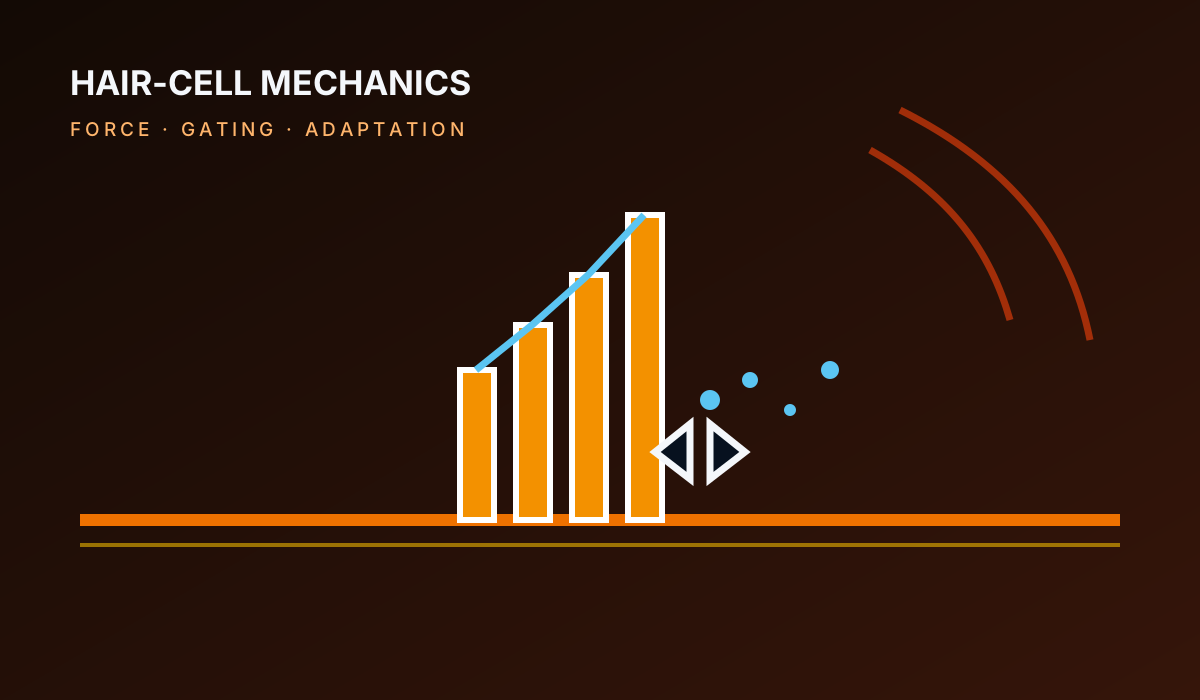
Membrane mechanics, adaptation and active force generation in sensory cells.

A placeholder programme connecting cholesterol, PIP2 and force relay to channel gating.
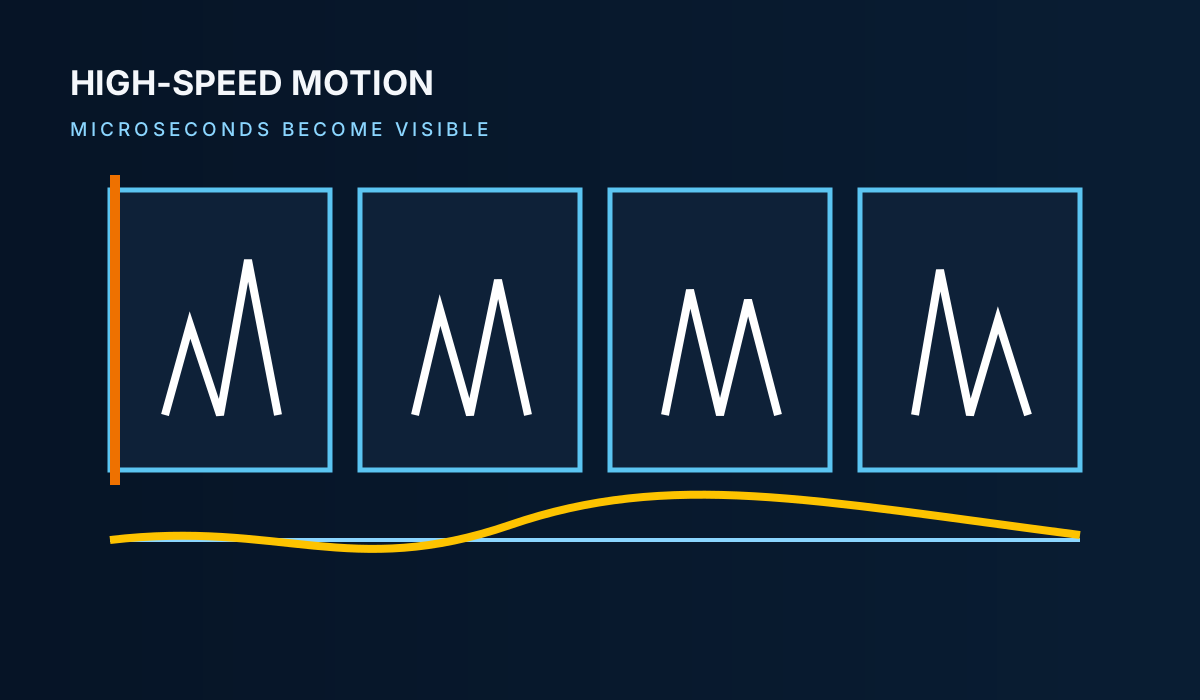
Visualising microsecond-scale hair-bundle and antennal motion.
How individual signals remain detectable inside dense acoustic groups.
New fluid-jet and force-delivery tools for controlled mechanical perturbations.

Linking receptor mechanics to spiking activity and behaviour.
A final feature panel could combine a short looping clip, a concise scientific question, a collaborator list and direct links to the associated paper, dataset and method. The background travels at a different speed from the copy so the image is gradually revealed while the foreground remains readable.
See methodsA possible narrative framework for explaining how projects develop in the lab.
Begin with a surprising movement, signal or behavioural pattern.
Build an assay that resolves the relevant mechanics and timescale.
Change molecules, forces or sensory context in a controlled way.
Link mechanics to neural signals and ultimately to behaviour.
Publish the evidence and make tools reusable wherever possible.
These are explicit placeholders for short first-person project blurbs.
“I am most interested in the point where a physical movement becomes a biological decision.”
Jörg · project lead“The fun part is building an experiment that lets us see a process which was previously too fast or too small.”
Thomas · experimental systems“A student project could begin with one clean measurement and grow into a much larger mechanistic story.”
Future student voiceMore placeholder content to suggest how deeper project pages might feel.
Possible links: current grant, membrane perturbation experiments, related publications.
Possible links: doublesex project, RNA-seq, mechanics and behavioural assays.
Possible links: nonlinear mechanics, adaptation, control theory and ageing.
Possible links: fluid-jet platform, high-speed camera pipeline and open hardware.