Research project

Deafness-gene avatars

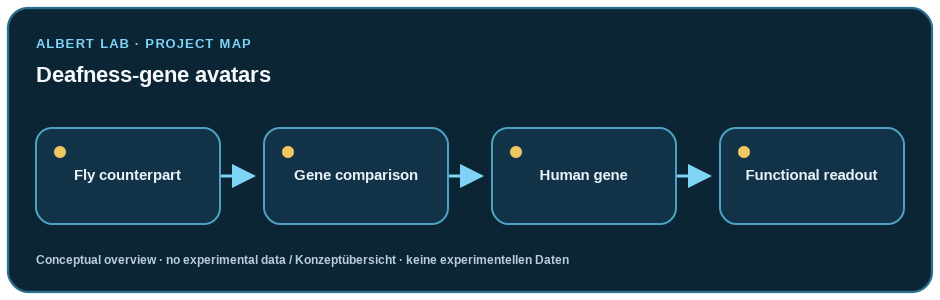
Identify the fly homologue of a human deafness gene, delete it, express the human gene and measure whether hearing is restored.
Project overview

At a glance

Identify the fly homologue of a human deafness gene, delete it, express the human gene and measure whether hearing is restored.

Concept overview for Deafness-gene avatars
Conceptual overview — schematic only, not experimental data.

Research question

Can a human deafness-gene counterpart support a measurable hearing-related function in a fly model?

Approach

A conceptual sequence is to identify a fly counterpart, create a loss-of-function comparison, express the human gene and assess a hearing-related readout without presuming rescue.

Model organisms
Drosophila melanogaster
Related methods
4 · Jump to methods
Publications
1 · Jump to linked papers

Research question

Research question

Can a human deafness-gene counterpart support a measurable hearing-related function in a fly model?

Approach

Approach

A conceptual sequence is to identify a fly counterpart, create a loss-of-function comparison, express the human gene and assess a hearing-related readout without presuming rescue.

Methods & resources

Techniques

Methods

Related methods

  • Electrophysiologyphysiology

    Patch clamp, extracellular recordings and mechanically evoked responses to connect force, motion and electrical signalling.

  • Molecular biologymolecular

    Genotyping, PCR, cloning, expression analysis and molecular perturbations used to link genes to sensory function.

  • Drosophila genetics & fly workmodel systems

    Fly genetics lets us study how genes shape hearing and test their effects in selected cells and across generations.

  • Behavioural assaysbehaviour

    Connecting sensory input to attraction, avoidance, orientation, courtship and movement in controlled environments.

Next steps

Next steps

A next planning step could specify suitable matched groups and a pre-defined hearing-related measure.