

Contributed by Saurav Ghimire
The fruit fly offers practical genetic tools for studying the Johnston’s organ, its sensory neurons, and hearing-related genes.
01
Why study hearing in flies?
In our lab, we ask which genes contribute to sound transduction, how mutations affect hearing, what happens when ciliary motor proteins or ion channels are altered, and whether specific auditory neurons can be silenced while neighboring cells remain intact. We also study how genetic changes may affect mechanical sensitivity and acoustic behavior. The fly’s Johnston’s organ (JO), inside the second antennal segment, contains mechanosensory chordotonal neurons. It shares molecular and biophysical features with parts of the human inner ear, but fly neurons are not identical to human hair cells.
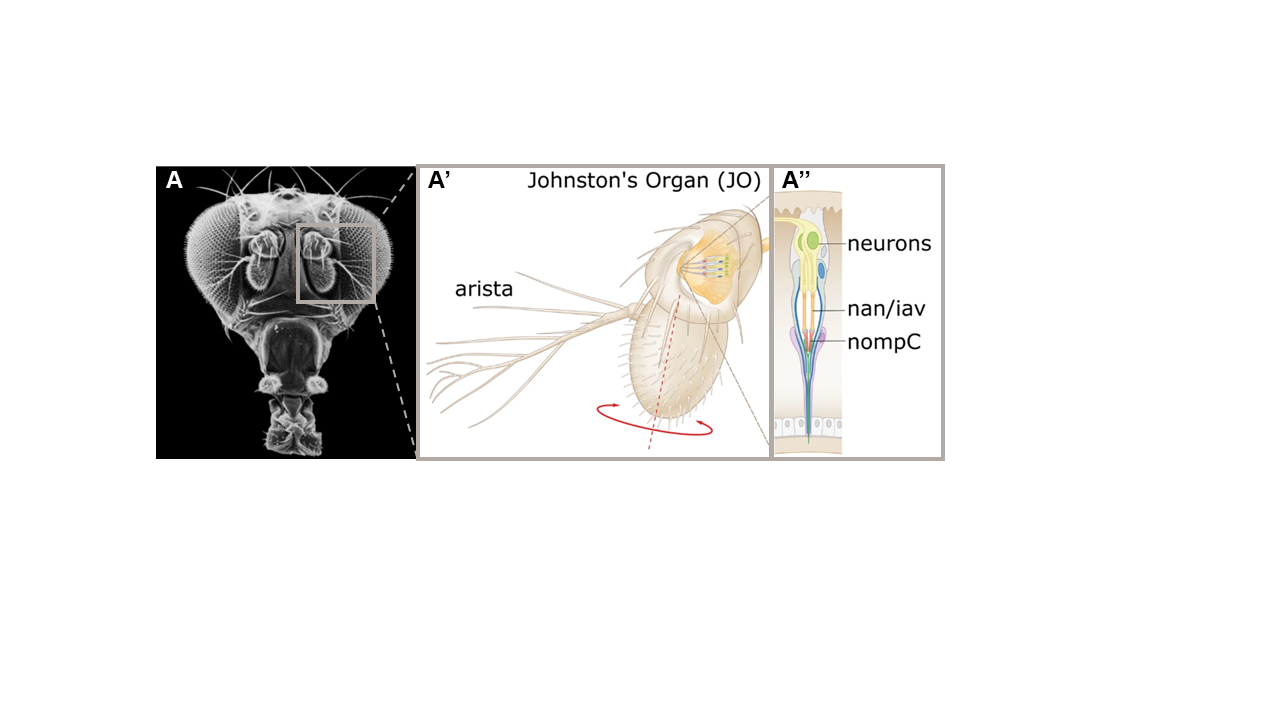
AI-assisted Van Gogh-inspired interpretation (not original data). Read scientific labels and traces from the original.
02
Chromosomes and recombination
Fruit flies have four chromosome pairs: three pairs of autosomes and one pair of sex chromosomes. During egg production, females can exchange DNA between homologous chromosomes through recombination. This can separate a mutation from other genetic features, so researchers use breeding strategies to maintain useful combinations for experiments over many generations.
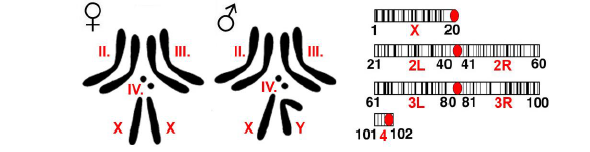
AI-assisted Van Gogh-inspired interpretation (not original data). Read scientific labels and traces from the original.
03
Balancer chromosomes and markers
Balancer chromosomes carry multiple inversions that suppress recombination in the relevant region. Many also carry visible markers that help identify flies, though marker traits vary and are not all dominant. Balancer homozygotes are often recessive lethal or sterile, but this depends on the particular balancer. These tools help preserve a mutation in a heterozygous stock; they do not guarantee that every unwanted recombinant is eliminated.
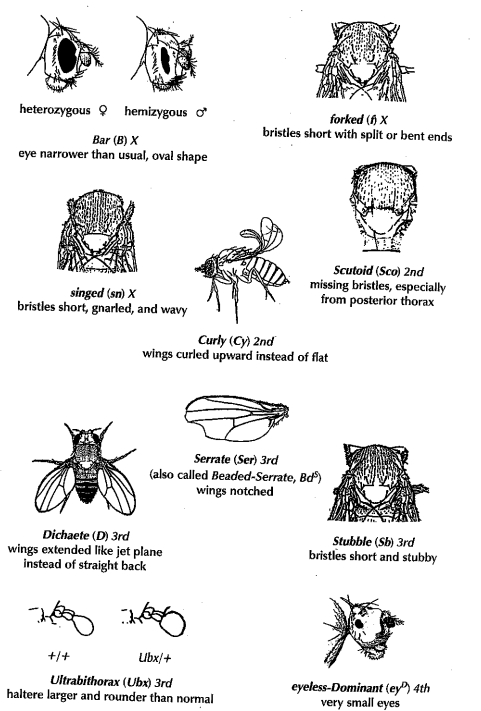
AI-assisted Van Gogh-inspired interpretation (not original data). Read scientific labels and traces from the original.
04
Following a genetic cross
A cross between mut/Balancer flies can produce mut/mut, mut/Balancer, and Balancer/Balancer offspring, subject to the alleles and balancer used. The balancer homozygotes may be nonviable or sterile; mutant homozygote viability and fertility depend on the mutation. A mut/Balancer self-cross therefore does not automatically maintain a stock: offspring must be scored and genotypes checked, and the breeding scheme adjusted as needed.
| Gametes | mut | Balancer |
|---|---|---|
| mut | mut / mut | mut / Balancer |
| Balancer | mut / Balancer | Balancer / Balancer |
05
Targeted genetic tools
The GAL4/UAS system can direct expression of a target gene to cells where a GAL4 driver is active; this includes reporters or RNAi constructs. RNA interference (RNAi) can reduce expression by promoting the breakdown of matching messenger RNA. CRISPR/Cas9 can be used to edit fly genes, for example to introduce variants, add fluorescent tags, or create disease-model lines. These approaches support tests of genes involved in hearing, ion channels, motor proteins, and neural signaling.
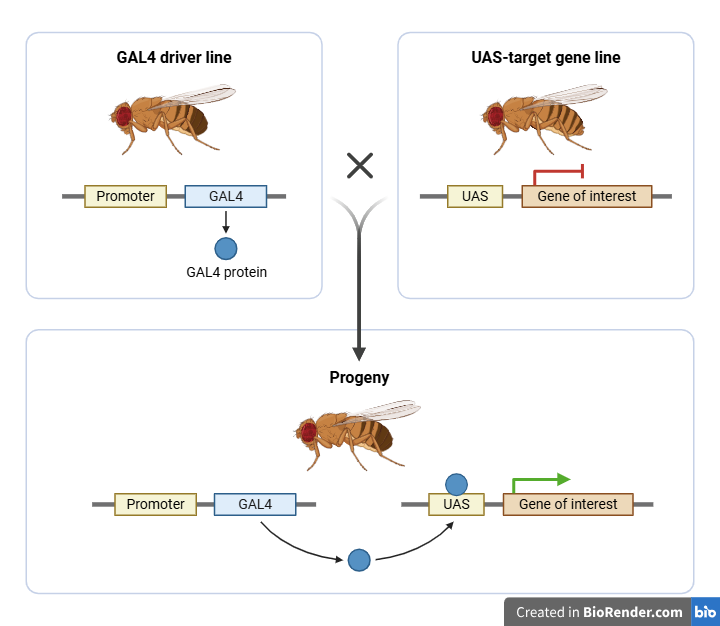
AI-assisted Van Gogh-inspired interpretation (not original data). Read scientific labels and traces from the original.
06
Fly work and rearing
Daily work includes sorting flies on a CO₂ pad, using dissecting and fluorescence microscopes, brushes, and fine forceps. Rearing temperature affects development and can provide temperature-sensitive control such as GAL80ts. Egg-to-adult development takes approximately 10 days at 25 °C and 20 days at 18 °C, depending on conditions and stock. Higher temperatures, such as 29 °C, can be used in suitable GAL4/GAL80ts experiments; the protocol and fly health determine the appropriate conditions.
07
Genotype validation and lab methods
Fly lines may be generated or modified using CRISPR/Cas9. PCR, qPCR, and sequencing can help confirm genotypes, with RNA or DNA quality checks as appropriate. Immunohistochemistry can help map cellular or tissue features. These methods complement stock management and targeted genetic approaches.