Where nonlinear distortion products arise and what they reveal about active auditory mechanics.
Project overview
At a glance
Where nonlinear distortion products arise and what they reveal about active auditory mechanics.
Research question
Where might nonlinear distortion products arise in fly hearing, and what could they reveal about active mechanics?
Approach
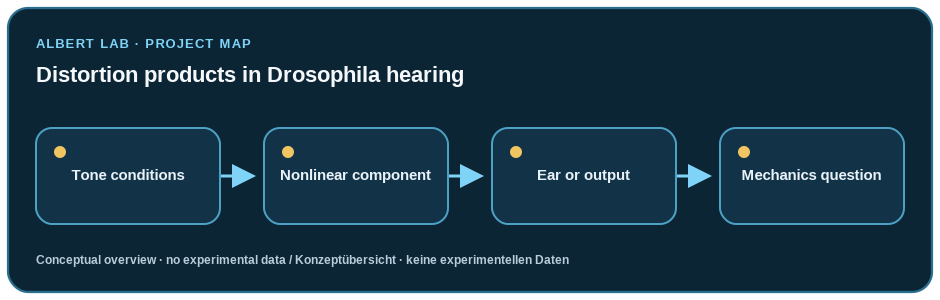
A proposed workflow would compare single-tone and paired-tone stimulation, identify candidate nonlinear components, and relate them to measurements at the ear or sensory output.
Model systems
Drosophila melanogaster
Related methods
Selected publications
- Mechanical signatures of transducer gating in the Drosophila ear.
- Transducer-based force generation explains active process in Drosophila…
- Turnover and activity-dependent transcriptional control of NompC in the…
Follow this project
- Programme
- Drosophila hearing
- Model organisms
- Drosophila melanogaster
- Related methods
- 3 · Jump to methods
- Publications
- 3 · Jump to linked papers