Research project

Mosquito hearing

How male mosquitoes maintain acoustic sensitivity to potential mates while flying and generating vibrations of their own.
Project overview

At a glance

How male mosquitoes maintain acoustic sensitivity to potential mates while flying and generating vibrations of their own.

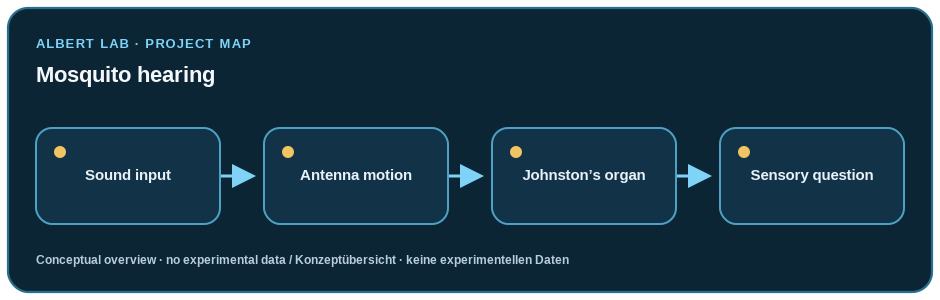
Concept overview for Mosquito hearing
Conceptual overview — schematic only, not experimental data.

Research question

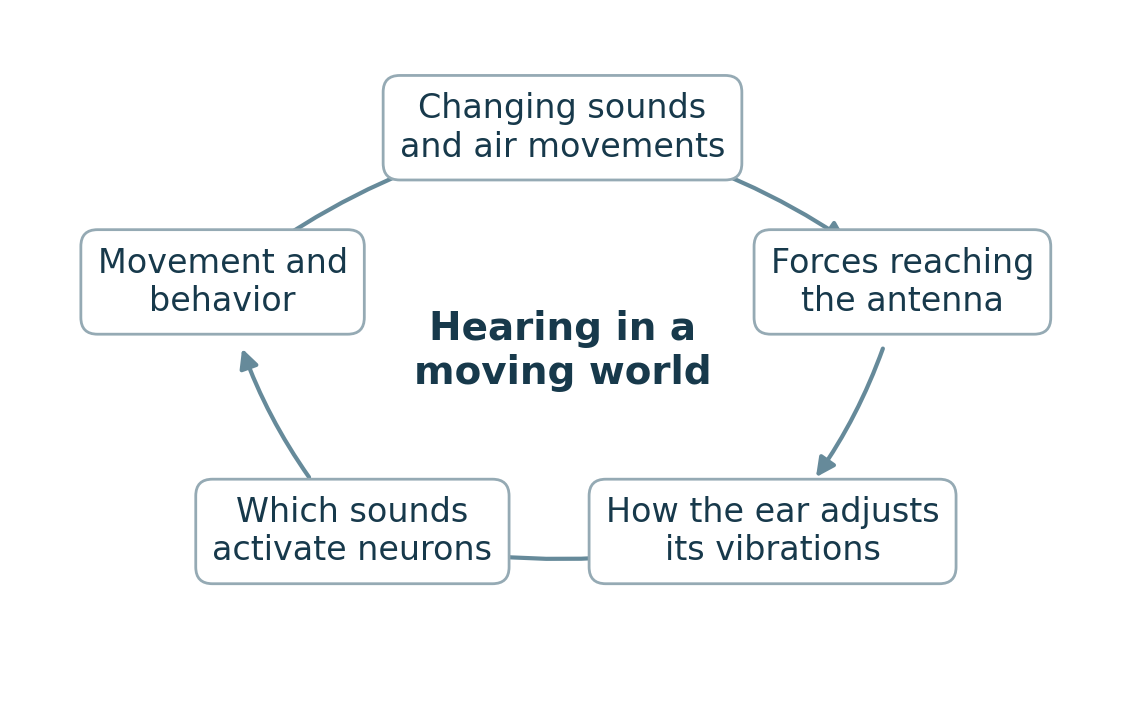
How do living-tissue mechanics and supporting-cell forces regulate antennal sensitivity and the conversion of sound-driven motion into sensory activity?

Approach

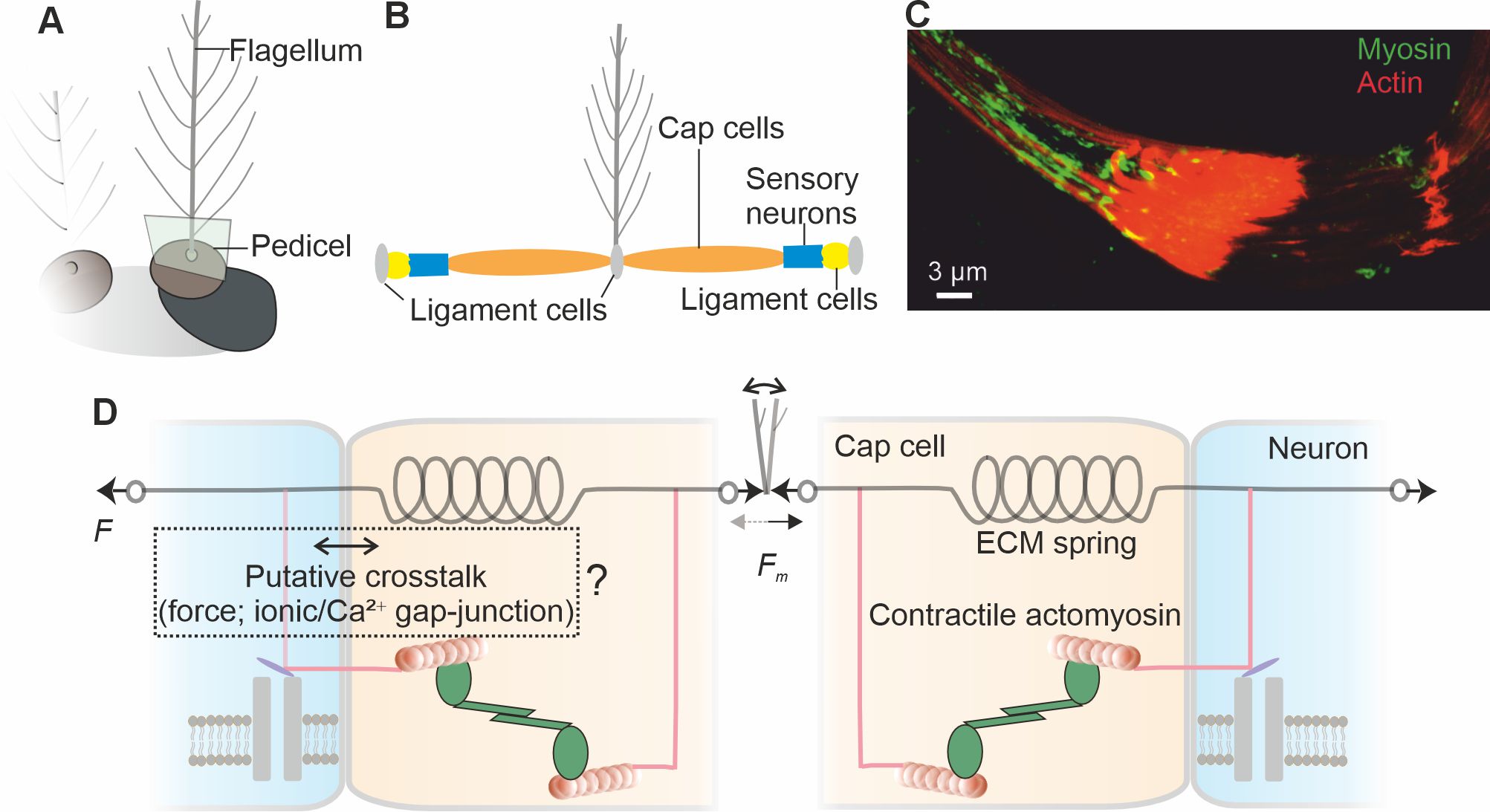
Mosquitoes hear with their antennae; sound-driven displacement reaches Johnston’s organ at the antennal base. We investigate how active organ mechanics, mechanical coupling, and supporting cells may set…

Model organisms
Mosquitoes
Related methods
4 · Jump to methods
Publications
5 · Jump to linked papers

Research question

Research question

How do living-tissue mechanics and supporting-cell forces regulate antennal sensitivity and the conversion of sound-driven motion into sensory activity?

Approach

Approach

Mosquitoes hear with their antennae; sound-driven displacement reaches Johnston’s organ at the antennal base. We investigate how active organ mechanics, mechanical coupling, and supporting cells may set sensitivity and selectivity. Self-sustained antennal oscillations provide a readout of internal force generation. Molecular candidates, including myosin-related motors, are considered alongside controlled mechanical stimulation and neural readouts. We use pharmacological perturbations in conjunction with movement measurements and electrophysiological recordings to distinguish changes in mechanical input from changes in neuronal activity. The aim is to link molecular processes, tissue-level mechanics, and organ function; this submitted text describes questions and approaches, not verified experimental outcomes.

Methods

Related methods

  • Laser Doppler vibrometrymechanics

    Non-contact measurements of nanometre-scale vibrations in antennae, chordotonal organs, hair bundles and other sensory structures.

  • Electrophysiologyphysiology

    Patch clamp, extracellular recordings and mechanically evoked responses to connect force, motion and electrical signalling.

  • Electrostatic actuationstimulation · current method

    Non-contact electrostatic stimulation for controlled force delivery to small sensory structures and mechanical receivers.

  • Mosquito workmodel systems

    Auditory physiology, sensory mechanics and behavioural assays in mosquitoes with a focus on sex-specific hearing and communication.

Current work

Current work

The contribution outlines two connected research directions: active antennal mechanics and neuropharmacological links between molecular regulation, organ motion, and sensory output. It asks whether mechanically active supporting cells tune the mosquito ear under changing conditions.

Next steps

Next steps

Evaluate antennal oscillations and neural responses under controlled mechanical and pharmacological conditions, with the project team confirming the precise protocols and milestones.