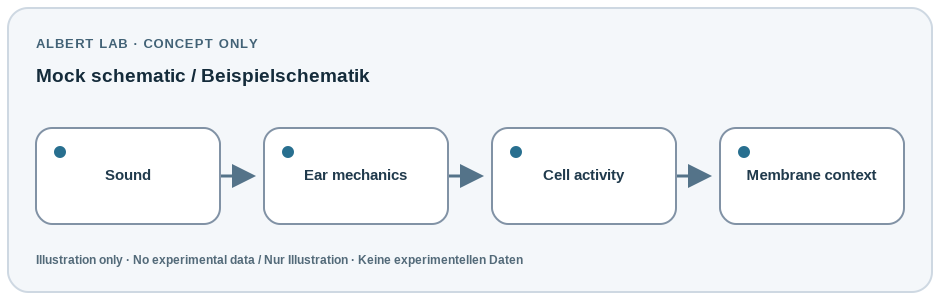
Using the fly auditory system to test: nonlinear auditory processing, organ mechanics, cellular activity and effects of cell membrane manipulations.
Project overview
At a glance
Using the fly auditory system to test: nonlinear auditory processing, organ mechanics, cellular activity and effects of cell membrane manipulations.
Research question
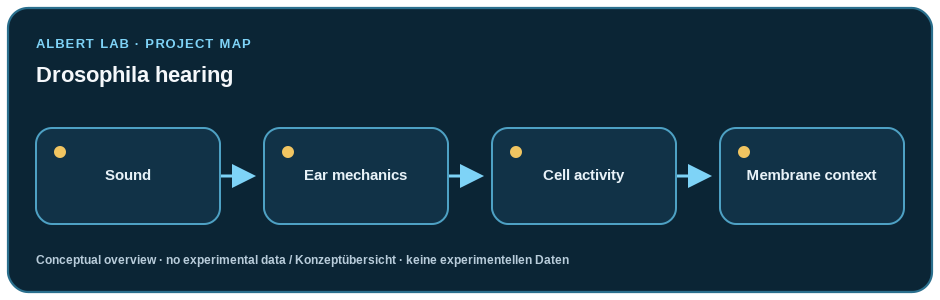
How could membrane properties, ear mechanics and cellular activity be connected in Drosophila hearing?
Approach
A proposed comparison would pair acoustic stimulation with measurements of organ motion and sensory activity, while treating membrane composition as a candidate influencing factor.
Model systems
Drosophila melanogaster
Related methods
Selected publications
- Turnover and activity-dependent transcriptional control of NompC in the…
- Mechanical signatures of transducer gating in the Drosophila ear.
- Transducer-based force generation explains active process in Drosophila…
- Hearing in Drosophila.
Follow this project
- Model organisms
- Drosophila melanogaster
- Related methods
- 3 · Jump to methods
- Publications
- 5 · Jump to linked papers